Tell us about the job
Takes about a minute. No obligation.
A contractor quoting a boiler repair in Clay County starts by looking at how the unit has been maintained, not at what the sky has thrown at it. 33 severe weather events were recorded in Clay County, Indiana between 2015 and 2024. At that rate, severe weather is an occasional event in this county, not a standing condition, and it does not accumulate the kind of load that pushes heating components past their limit ahead of schedule. Age and installation quality are the likelier culprits. That means a thorough diagnosis focuses on heat exchanger condition, burner performance, and service history before weather exposure enters the conversation at all.
Stock built before the mid-seventies has been through enough heating seasons to retire several generations of equipment, and what sits in a mechanical room today is rarely original to the house. Half the homes in Clay County, Indiana were built in 1974 or earlier (2020-2024 ACS 5-year). When a contractor opens a boiler in housing this old, the question is whether the heat exchanger shows fatigue cracks or scale buildup that makes repair impractical, and whether the controls and burner components the unit takes are still being manufactured. A system whose parts have gone out of production gets replaced, not repaired, and that call comes from what is inside the cabinet.
The Parts of a Boiler a Contractor Checks First
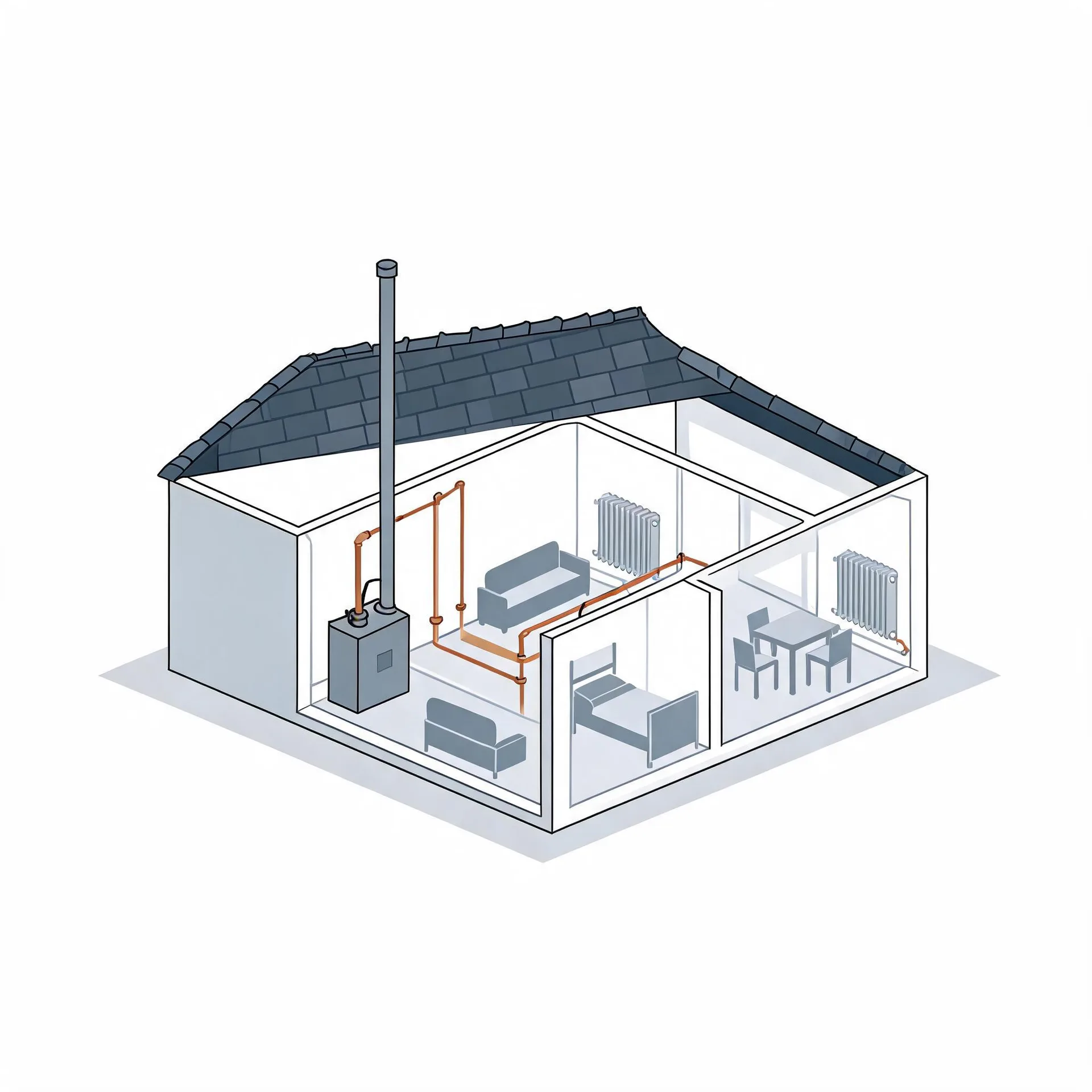
The boiler itself sits in the basement or mechanical room and is the heart of the system. It heats water and pushes it out through the distribution lines. When heat stops reaching the rooms, the contractor starts here, checking the burner, the heat exchanger, and the controls that tell the unit when to fire.
Radiators or baseboard units sit in each room and give off heat as hot water passes through them. Connecting them to the boiler are supply and return pipes that run through walls and floors. A circulator pump moves the water through that loop, and a faulty pump or a clogged section of pipe can cut off heat to part or all of the house.
The drawing shows a typical boiler layout, and a licensed contractor determines which components apply and what condition they are in for your specific home.
Find a contractor in Clay CountyClay County by the Numbers
33 severe weather events were recorded in Clay County, Indiana between 2015 and 2024.
NOAA National Centers for Environmental Information, Storm Events Database, bulk CSV export, events 2015-01-01 through 2024-12-31.Half the homes in Clay County, Indiana were built in 1974 or earlier (2020-2024 ACS 5-year).
U.S. Census Bureau, 2020-2024 American Community Survey 5-Year EstimatesClay County, Indiana holds 11,645 housing units (2020-2024 ACS 5-year).
U.S. Census Bureau, 2020-2024 American Community Survey 5-Year EstimatesOwners occupy 80.9% of the occupied homes in Clay County, Indiana (2020-2024 ACS 5-year).
U.S. Census Bureau, 2020-2024 American Community Survey 5-Year EstimatesSevere Weather Events in Clay County
Boilers work hardest when outside conditions put pressure on a home's thermal envelope. How often that pressure arrives in Clay County shapes how much wear local equipment absorbs over time, which makes weather history a practical part of understanding boiler repair demand here.
33 severe weather events, 2015–2024. Source: NOAA National Centers for Environmental Information, Storm Events Database.