Tell us about the job
Takes about a minute. No obligation.
A contractor called out for boiler trouble in Wayne County has to establish what actually wore the equipment down before committing to a repair scope. 94 severe weather events were recorded in Wayne County, Indiana between 2015 and 2024. That puts the county in the middle of the national picture, which means weather load is a real but modest factor in what components have been carrying. A heat exchanger that has cracked or a circulator pump that has seized is more likely tracing back to years of deferred maintenance or an undersized original install than to weather strain alone. The contractor checks both, but age and service history drive the diagnosis here.
Boilers in this county feed heat through distribution systems that, in a large share of homes, have never been replaced. Half the homes in Wayne County, Indiana were built in 1960 or earlier (2020-2024 ACS 5-year). Cast-iron radiators and aging pipe networks accumulate sediment, develop pinhole leaks, and lose their ability to balance pressure evenly across zones. When a contractor opens a boiler for repair, what they find inside the unit is only part of the answer. The distribution side sets the scope, and that is where the bill can shift.
The Parts of a Boiler a Contractor Checks First
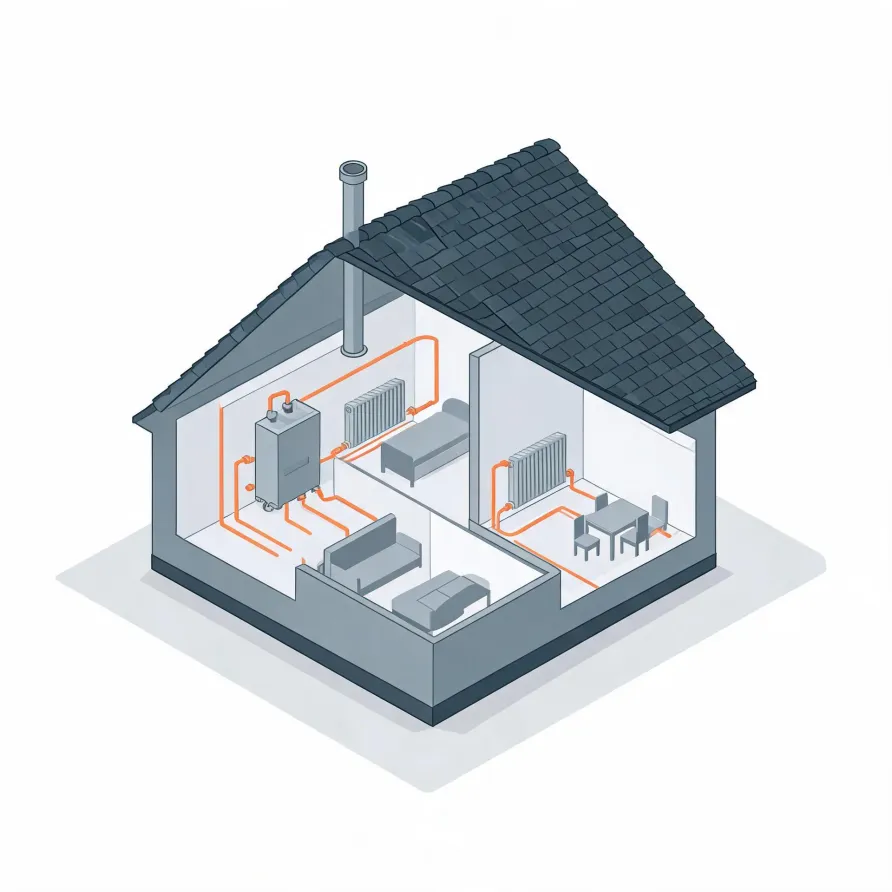
The boiler itself sits in the basement or a mechanical room and is the piece a contractor goes to first. Inside it, the heat exchanger is where combustion gases give up their heat to the water. When a boiler runs but fails to heat properly, or cycles on and off without reason, those two components are where the diagnosis begins.
The circulator pump moves heated water out through the supply pipes and pulls cooler water back through the return lines. The expansion tank, usually mounted near the boiler, absorbs pressure swings as the water heats and contracts. The pressure relief valve and the thermostat controls round out what a contractor reads and tests before any part is touched.
The drawing shows a typical boiler layout, and a licensed contractor determines which components apply and what condition each is in for your specific home.
Find a contractor in Wayne CountyWayne County, Indiana, by the numbers
94 severe weather events were recorded in Wayne County, Indiana between 2015 and 2024.
NOAA National Centers for Environmental Information, Storm Events Database, bulk CSV export, events 2015-01-01 through 2024-12-31.Half the homes in Wayne County, Indiana were built in 1960 or earlier (2020-2024 ACS 5-year).
U.S. Census Bureau, 2020-2024 American Community Survey 5-Year EstimatesWayne County, Indiana holds 30,736 housing units (2020-2024 ACS 5-year).
U.S. Census Bureau, 2020-2024 American Community Survey 5-Year EstimatesOwners occupy 69.2% of the occupied homes in Wayne County, Indiana (2020-2024 ACS 5-year).
U.S. Census Bureau, 2020-2024 American Community Survey 5-Year EstimatesSevere Weather Events in Wayne County
Boiler systems in Wayne County work hardest when outside conditions are most punishing. Weather puts hours on equipment, and those hours show up as wear that repair contractors see directly.
94 severe weather events, 2015–2024. Source: NOAA National Centers for Environmental Information, Storm Events Database.